

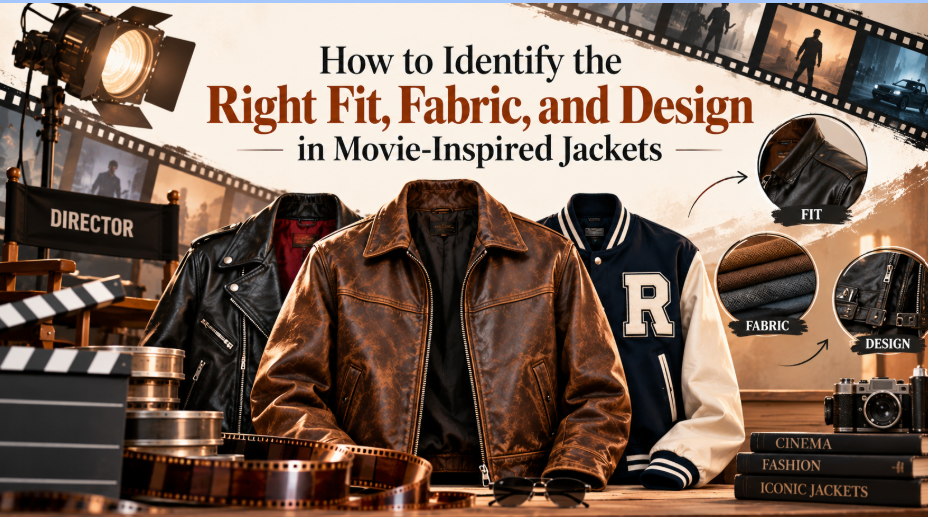
You’ve watched the film, you love the jacket, and now you’re staring at a dozen online listings that all claim to be “just like the one on screen.” Some look right in the photos. Some look suspiciously cheap. Telling them apart takes a little know-how. Movies Jackets are often built to look good for a few seconds on camera, not to survive years of real wear, so it pays to know what you’re actually buying. This guide covers the three things that matter most: fit, fabric, and design.
First, a bit of context. A costume jacket and a jacket you’d actually wear are two different objects. On a set, the piece might be altered to fit one actor perfectly, aged with sandpaper and paint, or duplicated five times for stunts. None of that tells you how a retail version will behave. So instead of chasing an exact replica, focus on the qualities that make any jacket good: proportions that suit you, materials that feel solid, and details that hold up.
Start With Fit
Fit decides whether a jacket looks like clothing or like a costume, so check it first.
Shoulders come first. The seam should sit at the edge of your shoulder bone. If it slides down your arm, the jacket is too big, and no amount of good design will fix that look. If the fabric pulls across your upper back when you reach forward, it’s too small.
Next, sleeves. They should end around your wrist bone, so a little shirt cuff can show. Leather and heavy wool sleeves are hard to shorten, so don’t count on tailoring.
Then length. Bombers and biker jackets usually finish at the waistband. Field coats and trench-style pieces can drop to mid-hip or lower. Think about the trousers and boots you wear most, and choose a length that balances them.
Finally, the body of the jacket. Zip it up or button it over the thickest layer you plan to wear, such as a sweater, then move around. Reach forward, raise your arms, sit down. If it feels restrictive now, it will feel worse after a few hours.
Film jackets are often cut slim because it looks sharp on camera. That’s fine if you like it, but don’t be afraid to size up if you need room for layers.
When you start comparing options, it helps to look at stores that organize their ranges by silhouette and material rather than by hype. A shop like Just American Jackets makes it easier to see how a flight jacket differs from a biker or a varsity style in weight, collar shape, and length, which is exactly the kind of comparison you need before spending money.
Read the Fabric Like a Label Detective
Fabric tells you more about a jacket than any marketing line. Here’s what to look for.
For leather, check the type. Cowhide is tough and heavy, lambskin is softer and lighter, and goatskin sits between them. Terms like “genuine leather” don’t say much about quality, while full-grain or top-grain suggest a better hide. Real leather should feel supple, with slight natural variation in the surface. If it looks perfectly uniform and plasticky, it may be a coated or bonded material.
For fabric jackets, look for the weight. Cotton twill, canvas, and wool blends all behave differently. A heavier wool holds warmth, while a light nylon suits spring and travel. If the listing doesn’t mention weight at all, that’s worth noting.
For satin and souvenir-style jackets, check the sheen and the stitching. Cheap satin looks glossy in a way that screams polyester, while better versions have a softer, more even glow. Embroidery should be dense and tidy, with no loose threads.
The lining is the quiet hero. Quilted linings add warmth, satin linings keep things light, and shearling or fleece suits serious cold. Match the lining to your climate, not to the film’s setting.
Judge the Design Details
Once fit and fabric make sense, look at the design. This is where a good jacket separates itself from a lazy copy.
Collars carry a lot of character. A flight jacket has a distinctive fur or shearling-style collar, a biker has snap-down lapels, and a bomber has a ribbed neckline. If the collar looks flat or badly shaped in the photos, the whole jacket will feel off.
Pockets matter too. Real pockets, with proper depth and finishing, are far more useful than decorative flaps. Check whether they’re zippered, snapped, or open, and make sure the position makes sense for your hands.
Hardware is easy to overlook, but it shows quality quickly. Zippers should glide smoothly, snaps should close with a firm click, and buckles should feel solid. Metal that looks thin or uneven usually fails first.
Stitching is your final check. Straight, even seams, especially around the collar, cuffs, and hem, point to careful work. Wavy lines or loose threads are a bad sign.
Many Celebrity Jackets borrow small details like patches, contrast panels, or distinctive trims, and those details are where cheap versions often cut corners. Zoom in on the product photos to see how they’re finished. If a patch looks printed rather than stitched, or an embroidered panel looks flat, expect the same level of shortcut elsewhere.
Spotting Warning Signs Online
Shopping online makes everything harder, so a few red flags are worth memorizing.
Vague descriptions. If the listing says “premium material” and nothing else, be careful. Good sellers name the leather type, the fabric blend, and the lining.
Stock photos only. Real product images from multiple angles, including the inside and close-ups of stitching, show that the seller has the item.
Price that doesn’t make sense. A genuine leather jacket at a very low price probably involves compromises somewhere, whether that’s the hide, the construction, or the finishing.
No size chart. Without actual measurements, you’re guessing. Look for chest, shoulder, sleeve, and length figures, and compare them against a jacket you already own and like.
Unclear returns. A fair return policy is a sign the seller expects honest fit questions. If it’s confusing or very restrictive, think twice.
Match the Jacket to Your Life
A jacket that’s perfect on screen might not suit your routine. Think about climate first. Leather and wool handle cold well, while nylon and cotton are better for mild weather. Think about maintenance as well. Leather needs conditioning, suede needs protection from rain, and satin needs gentle handling.
Then consider how you dress. If most of your wardrobe is plain and neutral, a bold design will stand out nicely. If you already wear a lot of statement pieces, a subtler jacket might serve you better. The goal is something you’ll reach for without a second thought.
Final Thoughts
Choosing a movie-inspired jacket comes down to three honest questions. Does it fit your shoulders and sleeves properly? Is the fabric solid and suited to your climate? Are the design details well made, not just copied in outline? If the answer to all three is yes, the film reference is a bonus rather than the whole point. That’s how you end up with a jacket that looks great now and still feels right years from now.




Leave a Reply